Ecofrontiers is an applied research agency for the onchain economy. We produce original scholarship on institutional design, tokenized systems, AI coordination, and protocol architecture — then turn it into advisory work, products, and public-good platforms.
Most agencies either publish or build. We do both — and each feeds the other. Our original research produces the frameworks, taxonomies, and institutional models that inform our advisory work and the platforms we ship.
Clients don't get generic strategy. They get recommendations grounded in published, peer-tested intellectual infrastructure.
Original scholarship — books, essays, taxonomies, and frameworks.
Strategic counsel on tokenized assets, governance, AI coordination, and protocol economics.
Central banks, universities, foundations, and public institutions.
Engagements
Open-source platforms, public-good infrastructure, and experimental products.
Platforms
Regen Atlas (public good), Spiritus (stealth)
Four domains of practice, each informed by its own body of original research. Environmental finance is our deepest vertical — the others represent the expanding frontier of our work.
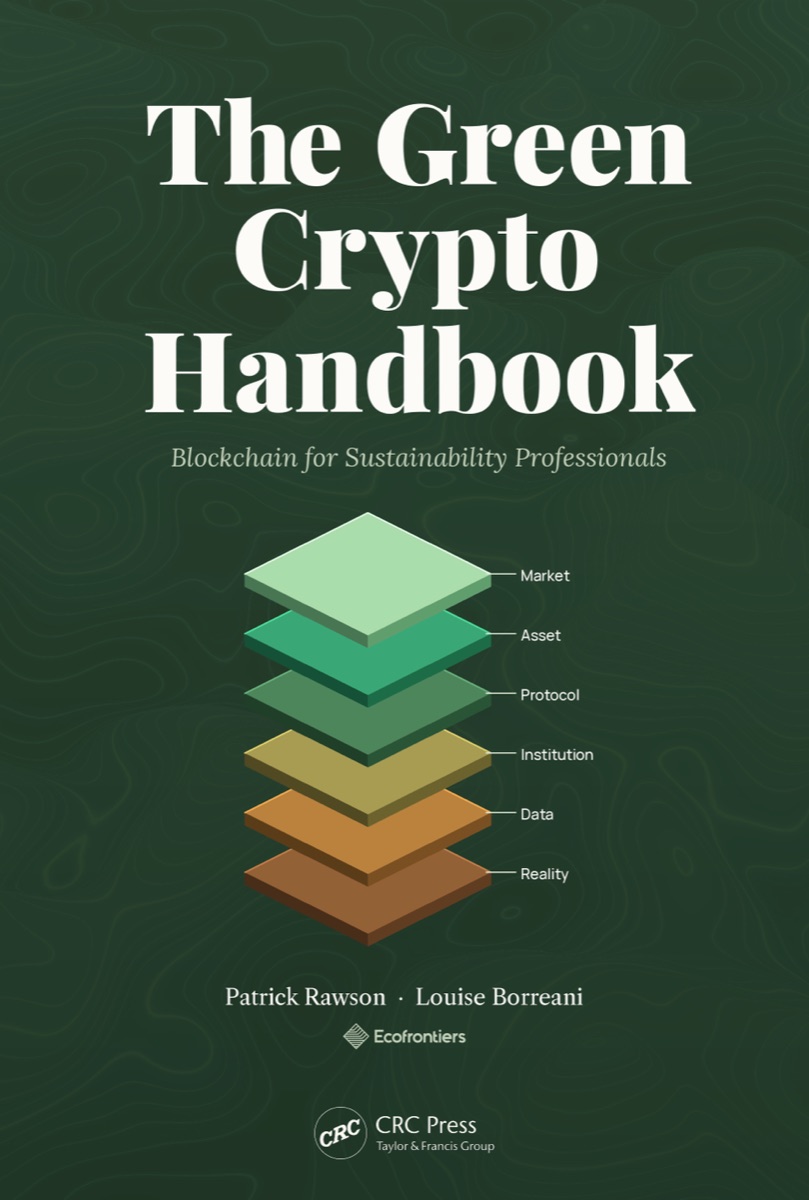
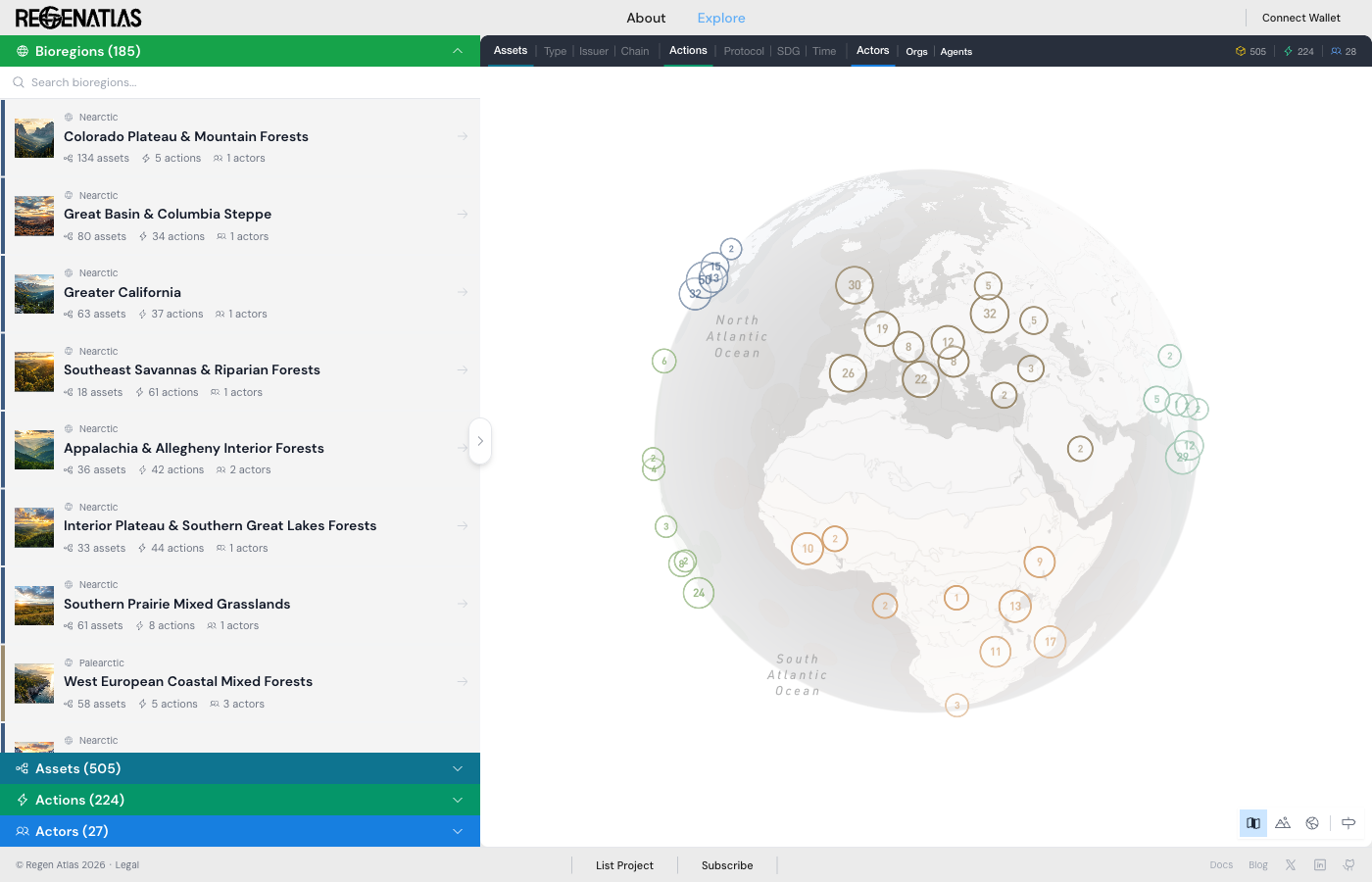
Our deepest body of work. The Green Crypto Handbook formalizes a six-layer model for how tokenized natural capital is produced. The Regen Atlas catalogues ~400 green crypto assets as open-source knowledge infrastructure. Our DePIN research on Glow's solar architecture was published in CarbonCopy. Our taxonomy of 8 asset types and 30 subtypes has been presented at central banks and academic conferences.
Projects & Clients
Engaging with central banks, foundations, universities, and public institutions navigating the intersection of blockchain, AI, and public interest. We present research at academic workshops, deliver guest lectures, examine students, and advise on institutional adoption of emerging technologies.
Engagements
Le Lab Banque de France · Central Bank of Uruguay · Sciences Po Paris · Alyra · Giga · Sostento
End-to-end product thinking for web3 ventures — from concept through launch. We build our own products and advise organizations on token-mediated identity, AI-native agents, onchain reputation, and consumer web3 experiences. We helped Inhabit go from idea to its first NFT collection for land stewardship in Colombia.
Projects & Clients
Regen Atlas · Spiritus
Mapping the gaps where institutional economics, protocol engineering, and AI coordination are converging faster than existing frameworks can keep up. The AI Institutional Design Gap Library identifies the missing connective tissue between these fields — and the emerging practice of the AI mechanism designer.
Projects & Outputs
AI Institutional Design Gap Library · "AI Mechanism Designer"
Public Sector
Research presentation on green crypto asset taxonomy and the Web3 Environmental Finance Stack for the central bank's innovation lab.
Speaking · Public Sector
Presented the green crypto asset taxonomy at the P2P Financial Systems Workshop hosted by the Central Bank of Uruguay.
Tokenomics Workshop · Public Sector
Delivered a tokenomics workshop for UNICEF's Giga initiative on blockchain-based school connectivity incentives and tokenized impact measurement.
Speaking · Academia
Guest lecture at Sciences Po Paris on sustainable blockchain applications and institutional design.
Advisory · Research
Advisory to the Celo Foundation. Former program coordinators of Celo's regenerative finance program. Mapping and taxonomy of the Celo ReFi ecosystem.
Education
External examiners at France's leading blockchain and AI school. Deliver lectures on the Protocol Layer of the Green Crypto Handbook.
White Paper · Advisory
Contributions to the Inverter white paper and strategic advisory on modular smart contract framework, incentive architecture, and governance mechanism design.
Advisory · Product Vision
Advisory with inputs to Inhabit's tokenomics and white paper. Designed the NFT collection architecture for land stewardship in Colombia.
Research
Published case study on Glow's decentralized solar architecture and DePIN incentive model in CarbonCopy.
Advisory Board
Member of Sostento's Crypto Advisory Board. Contributing to the strategic use of blockchain for healthcare access and humanitarian funding.
A 117,910-word volume accepted by an academic publisher, formalizing the Web3 Environmental Finance Stack — a six-layer model for how tokenized natural capital is collectively produced, from the observation of material reality to virtual market exchange. Introduces a taxonomy of 8 green crypto asset types and 30 subtypes, presented at the Central Bank of Uruguay and Sciences Po Paris.
Related Publications
Bring these frameworks into your organization
We offer workshops and advisory engagements grounded in the Handbook's taxonomy and layer model — tailored to your protocol, product, or institutional context.
Discuss an EngagementThe exchange layer where tokenized environmental assets are traded, priced, and allocated.
Uniswap, Carbonmark, Coinbase
The tokenized representation of environmental value. Our taxonomy identifies 8 asset types and 30 subtypes.
CHAR, REC tokens, tokenized green bonds
The smart contract logic and cryptoeconomic mechanisms that govern how environmental assets are created, transferred, retired, and composed.
Toucan Protocol, Regen Network, Glow
The governance bodies, DAOs, registries, and standards organizations that establish rules, verify claims, and coordinate collective action.
Verra, Gold Standard, KlimaDAO governance, Regen Registry
The observation, measurement, and reporting infrastructure that translates material reality into digital claims.
dMRV platforms, dClimate, Astral Protocol, Chainlink oracles
The physical, ecological, and thermodynamic substrate that all environmental claims must ultimately reference.
Ecosystem services, renewable energy generation, biodiversity
A structured inventory of unresolved design problems where AI systems meet institutional governance. Maps the gaps: where theory is missing, tools don't exist, and practitioners improvise without shared language.
Related Essays
Open-source knowledge infrastructure for regenerative finance. Catalogues ~400 green crypto assets using our 8-type, 30-subtype taxonomy. Freely accessible, community-maintained, lowering the barrier to a fragmented landscape.
Related Resources
What happens when tokenized collectibles develop persistent identity? Each item becomes an autonomous companion — developing personality, remembering interactions, holding territory on a shared map. A testbed for AI-native agents and token-mediated identity.
Institutional economics, protocol engineering, and AI coordination are converging on a practice nobody trained for. This essay maps the emerging role of the AI mechanism designer — the person who shapes how artificial agents participate in collective decision-making systems.
Read essay → Dec 2025 · Devcon ScholarReflections on public-good funding mechanisms after Devconnect. Written as part of the Devcon Scholar program, exploring how coordination tools evolve faster than the institutions that deploy them.
Read essay → Oct 2025 · SpeculativeA speculative imaginary on what happens when protocols begin internalizing thermodynamic constraints. Explores how intent-centric architectures might embed physical-world costs directly into transaction logic.
Read essay →Selected as a Devcon Scholar. Workshop at Funding the Commons on protocol actions for public goods.
Presented the green crypto asset taxonomy at the P2P Financial Systems Workshop.
Presented the Regen Atlas and green RWA tokenization taxonomy.
Guest lecture on sustainable blockchain applications and institutional design.
External examiners. Lecture on the Protocol Layer of the Handbook.
Panelist on the Climate & Environment conversation at the BFG Unconference during EthCC in Brussels.